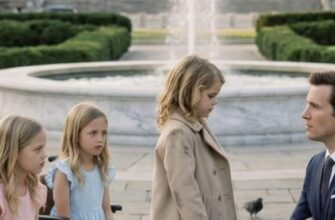
“Natasa, we’re already on the highway. We’ll be there by evening. Free up the second room — there are seven of us,” there was no “hello” or pause on the phone.
Only that voice, steady and unyielding, like a voicemail message. “Valya. Wait. Are you asking or informing?” “Informing. We’re already on the way.”
Natasa took the phone away from her ear and looked out the window for a few seconds.
Behind the glass the sea shimmered — turquoise, hot, July. She and Andrey had rented this apartment in March: two rooms, a veranda, a view of the bay, for the money they had saved up over half a year.
They had come here as a celebration — the first proper vacation in three years. Andrey was sitting on the veranda and had heard the conversation. When Natasa put down the phone, he set his glass on the table.
“I didn’t invite them.” “I know.” “What do we do?” Natasa fell silent. Then she smiled slowly — not the kind of smile people use to reconcile, but the kind used when a decision is made. “Let them come.”
Andrey looked at her with slight concern. He knew that smile. They had rented the apartment from an old friend of Natasa’s named Roman, from her university days.
Roman lived in Krasnodar, but every summer he rented out his seaside apartment — properly, with a contract, at market price. Twenty minutes after Valya’s call, Natasa called him.
“Roma, I have a strange request.” “I’m listening.” “You were coming for documents in three days anyway, right?” “In theory, yes. What happened?” “Nothing serious. I just need you as the owner.
In fact, you are the owner. Be the owner.” Roman was silent for a moment. “I understand. Let’s play.” Valentina arrived at half past seven in the evening.
She entered first — with four large bags, which she placed in the hallway before anyone could say anything.

After her came three children between the ages of seven and twelve, Kolesya’s husband Kostya, the mother-in-law Zinaida Pavlovna, and a cousin in his early twenties, Vitia, who only said: “What’s the Wi-Fi password?”
“Well, here we are!” Valentina spread her arms and looked around with satisfaction, as if she were the hostess. “God, it’s beautiful here. And you can see the sea! Kids, look at the sea!”
The children ran out onto the veranda. Zinaida Pavlovna went into the kitchen and started inspecting the cupboards. Kostya put the cooler bag down by the wall. Vitia found an outlet and disappeared into his phone.
“Valya,” Natasa said when the noise quieted a little, “there’s something you need to know. This apartment is rented. We are not the owners. The owner rents it out for ten thousand rubles a day.” A pause.
Long. “How much?” Valentina looked at her. “Ten thousand. For the whole apartment. That’s the price in July. You can check anywhere.” “But you live here.”
“We pay. Just like you would pay. We didn’t invite you.” Valentina opened her mouth, then closed it. She looked at Kostya, who was staring at the water as if seeing it for the first time in his life. Then back at Natasa.
“Fine,” she said, and in her voice appeared that layer Natasa had recognized for twelve years: calm on the surface, waiting underneath for everything to resolve itself. “Three days, and we’ll leave.
Kids, sea… you understand.” “I understand,” said Natasa. The three days passed exactly as she had expected. On the first morning Zinaida Pavlovna rearranged the kitchen.
The children walked through the apartment with wet feet, leaving stains on the couch and dropping towels onto the lower balcony. Vitia took the best sofa, listened to music, and did nothing to help.
Valentina opened the fridge as if it were hers. Andrey went to the beach every morning. Natasa worked from a distance, laptop on her knees, headphones on, at the edge of the veranda.
On the fourth morning Natasa placed a printed sheet on the table. “What is this?” “An invoice. Three nights. Seven people. Thirty thousand rubles.” Valentina read slowly, as if the numbers might change on their own.
“You’re serious.” “Completely.” “Natasa… we are relatives. Family. Do you understand what that means?” “I understand. That’s why I told you the price on the first evening.” “You didn’t tell us — you stated it as a fact!”
“You stated as a fact that you were coming. We’re even.” Valentina stood up. “We won’t pay a single ruble. This is absurd. We’re leaving today, and you’ll regret what you did to family.” Natasa nodded and dialed.
Roman arrived within forty minutes. “Good day,” he said, looking them over. “I am the owner. The contract exists only with these people.
There is no agreement with you. I did not authorize your stay. The apartment must be empty within one hour.” “What is this…” Valentina started. “This is unlawful use without payment or contract,” said Roman.
Kostya looked at him, then at Valya, then stood up and started packing. It took a long time. In the end Valentina stopped in the doorway. “Did Andrey know about this?” “From the first day,” said Andrey.
The door closed softly. In the evening the three of them sat on the veranda. “The invoice wasn’t paid,” Roman noted. “It wasn’t about the money,” said Natasa. “Then what?” “So they would leave on their own.
Without conflict.” Eight days later Andrey handed her his phone. Valentina had written a long message, full of old grievances and questions about the meaning of family, but accidentally sent it to the family group chat.
Their mother, Vera Nikolayevna, wrote: “Valya, you didn’t ask Natasa, you just stated you were coming. That’s not how you treat family. It’s unpleasant to read this.” No one wrote anything else. Natasa stepped to the window.
Outside was an ordinary courtyard, no sea. She felt no triumph. She felt no guilt either. Only a clear, straight feeling that the boundary in this story had not been blurred. And she had not crossed it.
They say you should give in in a family. That is true. But no one says how far.
And what happens when giving in is turned into obligation again and again.
Natasa knew the answer. It cost thirty thousand rubles. And she didn’t pay a single ruble for it.